República del Paraguay · Residency by Investment
A single qualifying investment grants direct permanent residency in one of South America's fastest-growing economies. Established under Resolution N° 0283/2026, the Investor Pass bypasses the temporary-residency stage entirely — with a clear pathway, in time, to citizenship by naturalisation.

What it is
The Investor Pass is Paraguay's investment-linked route to direct permanent residency. A qualifying investment is certified by the Foreign Investor Certificate — the Constancia de Inversionista Extranjero (CIE) — after which the permanent residency application proceeds with the national migration authority, without the usual two-year temporary stage.
Citizenship is a separate, later step: after the constitutional period of residence, a permanent resident may apply for citizenship by naturalisation. It is part of the journey — but residency is the destination most investors are buying.
The law · quoted
The Investor Pass is established by Resolution N° 0283/2026 of Paraguay's Ministry of Industry and Commerce (MIC), signed on 21 April 2026 in coordination with the Dirección Nacional de Migraciones. It rebuilds the framework for the Constancia de Inversionista Extranjero (CIE), abrogating the earlier Resolution N° 1052/2025, and grants foreign investors direct access to permanent residency.

| Programme | Investor Pass — direct permanent residency |
|---|---|
| Legal basis | Resolution N° 0283/2026 (MIC) |
| Investor certificate | CIE — issued by the MIC within ~5 business days |
| Residency | Permanent, granted by Migraciones (several months) |
| Maintenance | At least one visit every three years |
| Tax model | Territorial — foreign-source income generally untaxed |
Why Paraguay
This is not a frontier bet. Paraguay reached investment grade with Moody's in 2024 (Baa3) and S&P in 2025 (BBB-) — and every comparable market that crossed that line saw a decade of sustained property appreciation. The Investor Pass is simply the door in.
The market
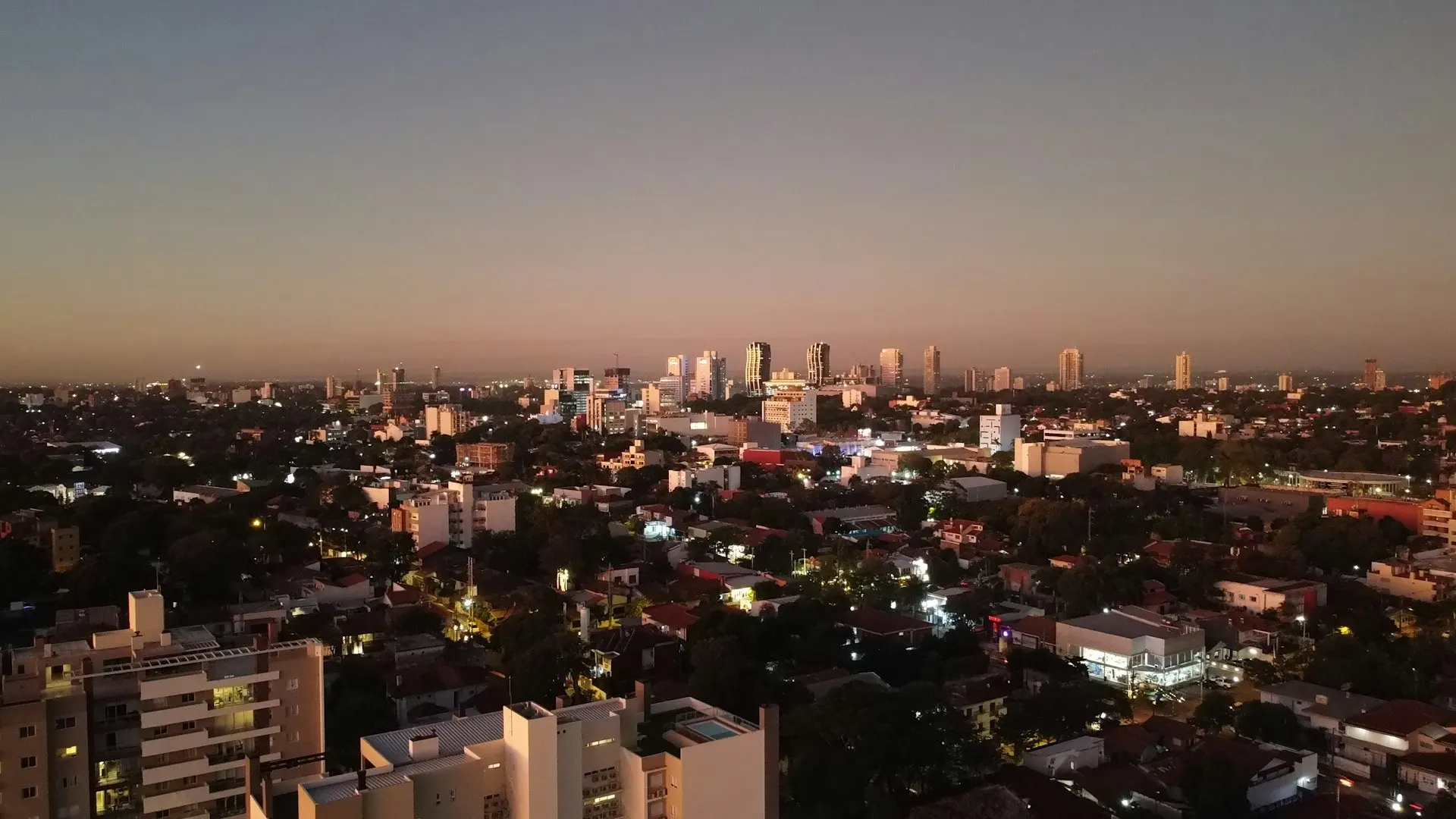
Asunción's skyline is being rewritten. Paraguay's tallest building, Petra Tower (172m), topped out in 2025; Petra Imperiale is planned to reach 250m; and developers like CIVIS are delivering 50-storey towers in Las Lomas. Behind the towers is real demand in a fast-urbanising capital.
For investors, the appeal is clean. Gross rental yields in Asunción typically run 6–8% for residential and up to around 12% for commercial or mixed-use, in USD — in a territorial, dollar-friendly system where foreigners buy freely, on a passport alone.

| Residential yields | ~6–8% gross per year, in USD |
|---|---|
| Commercial / mixed-use | Up to ~12% gross, in USD |
| Income tax | 10% flat — among the lowest in the region |
| Worldwide income | Not taxed (territorial system) |
| Foreign ownership | Unrestricted — passport sufficient |
| Currency | Stable guaraní; dollar-denominated deals common |
The investment options
Each route leads into the same residency framework. They differ in capital, control, and what you actually own at the end.
The first four routes are the qualifying options under Resolution 0283/2026. The film contribution is a separate, pre-existing pathway via Paraguay's audiovisual institute (INAP), included here for completeness.
The fundamentals
Income generated outside Paraguay is generally outside the scope of local income tax, and the headline rate is a flat 10%. Legal residency and tax residency remain separate questions — but the underlying model is among the most rational in the region.
The cost of living and doing business is a fraction of comparable jurisdictions, and qualifying property can be filed once at least 30% of the declared value is paid. Capital goes further here than almost anywhere in the Americas.
The Investor Pass grants permanent residency directly — no two-year temporary stage — and it is maintained with at least one visit every three years. Residency you hold, not residency you rent.
Paraguay sits at the centre of Mercosur, bordered by Brazil and Argentina. It is the strategic anchor of a wider regional footprint — your foothold in a continent of options.
A stable currency, investment-grade ratings, an open posture toward foreign investment, and recognition of dual citizenship in defined circumstances. Paraguay does not punish you for being international.
And, in time, optionality: after the qualifying period of permanent residence, eligibility to apply for citizenship by naturalisation. A later step — but a real one.
Who the programme is for
Americans, Europeans, and Australians who want a credible second base outside their home jurisdiction — before circumstances force the question.
Founders and operators who want a low-friction company, a territorial tax footing, and a foothold in Mercosur to build from.
Families building deliberately toward a second passport, who understand that the strongest position is the one secured early.
Optionality, secured deliberately.
Go deeper
Beyond the five routes — the requirements, the true cost, the tax and citizenship picture, and how Paraguay compares.
Every document and eligibility rule, in one definitive checklist.
The full cost of each route — qualifying investment, government and legal fees.
How territorial tax works, and why legal residency and tax residency are not the same thing.
The naturalisation path after residency — not citizenship by investment.
An honest, decision-stage comparison of the two most-asked-about routes.
Cost, tax system and lifestyle, compared without spin.
Frequently asked
It is Paraguay's investment-linked residency framework, established by Resolution N° 0283/2026. A qualifying investment through an approved route gives you access to the Foreign Investor Certificate (CIE) and the permanent residency process — and, after the constitutional residence period, the right to apply for citizenship by naturalisation.
Resolution 0283/2026 sets four routes: a company capitalised through SUACE from USD 70,000, approved tourism projects from USD 150,000, real estate from USD 200,000, and financial instruments from USD 200,000. A separate, pre-existing pathway via Paraguay's audiovisual institute allows residency through a film-production contribution from approximately USD 40,000. We help you choose the route that matches your strategy, not just your budget.
No. The MIC must issue the Foreign Investor Certificate (CIE) within five business days of a complete application, but it is a distinct investor credential. Permanent residency is a separate status granted by the migration authority, with its own process and timeline. We keep the two clearly apart — and so does the law.
Paraguay's Constitution (Art. 148) permits an application for naturalisation after three years of permanent residence, subject to language, civics, and physical-presence requirements, with further administrative processing time. Citizenship is granted through naturalisation — it is not conferred by the investment itself.
Paraguay applies a territorial tax system, so income arising outside Paraguay is generally outside the scope of Paraguayan income tax. Legal residency and tax residency are separate concepts: holding an Investor Pass does not by itself determine where you are tax resident. We assess that individually, within your wider structure.
Family members can generally be included in an Investor Pass application. The specifics depend on your circumstances and the route chosen, and are confirmed before anything is committed.

Begin your application
Residency by investment in the Republic of Paraguay.
Request guidance on the Investor Pass and the route best suited to your circumstances.
Last reviewed against Resolution N° 0283/2026 and current official fee schedules.
From our insights
SUACE is Paraguay's one-stop company system. Here is what it actually does, and how the USD 70,000 SUACE business route to residency works.
Read the guide →How Paraguay's territorial tax system actually works: what counts as foreign-source income, headline rates, and why it isn't the same as tax residency.
Read the guide →An even-handed look at Paraguay as a second residency: what it does well, where it genuinely falls short, and who it actually suits.
Read the guide →